
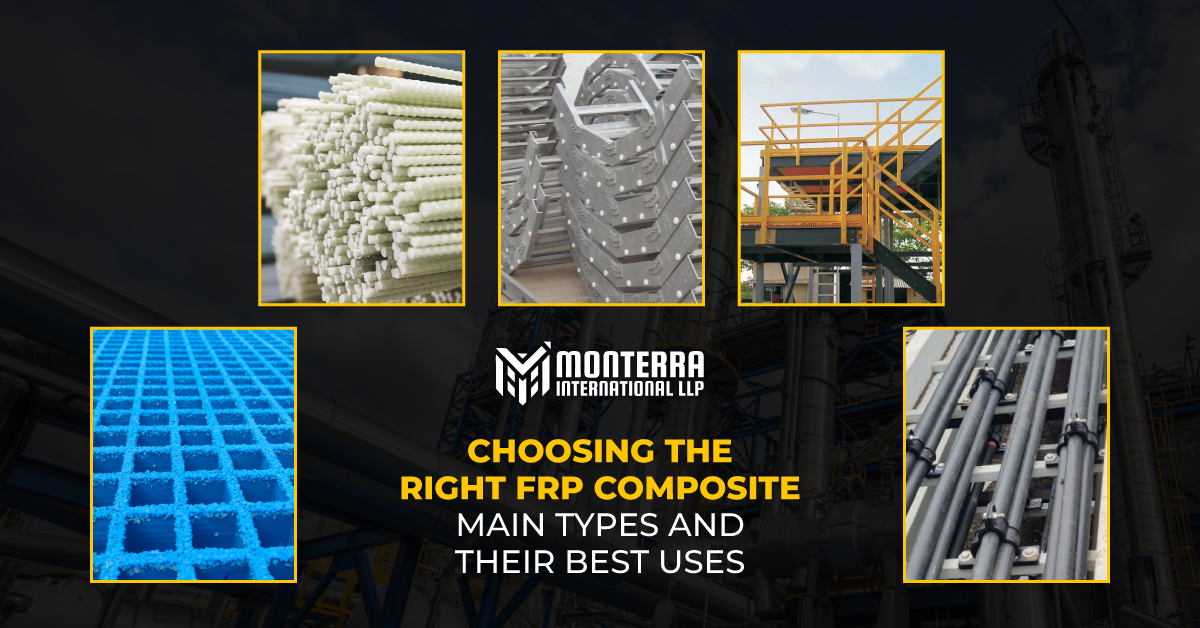
If you’ve spent any time in industrial construction or infrastructure management lately, you’ve likely noticed a shift. The heavy, rusted steel beams and the rotting timber planks of the past are being quietly replaced by something sleeker, lighter, and incredibly durable: FRP (Fiber Reinforced Polymer) Composites.
But here’s the thing—just saying "we need FRP" is a bit like saying "I need a vehicle." Are you hauling ten tons of gravel, or are you racing on a track? The specific type of FRP you choose depends entirely on the environment it’s going into. Whether you’re dealing with the corrosive salt air of an offshore rig or the high-voltage environment of a power substation, picking the right profile matters.
In this guide, we’re breaking down the heavy hitters of the FRP world—from FRP Structural Profiles to FRP/GRP Roofing Sheets—to help you figure out exactly what fits your next project.
When we talk about FRP Structural Profiles, we’re talking about the I-beams, channels, angles, and tubes that form the "bones" of a structure. Unlike steel, which requires a crane and a welding crew, these profiles are "pultruded"—a process that pulls glass fibers through a resin bath and a heated die.
Why they win:
Corrosion Resistance: They don’t rust. Period.
Managing cables in an industrial setting isn't just about organization; it's about survival. Traditional metal trays can become "live" if a wire shorts, and they corrode quickly in harsh environments. FRP Cable Trays solve both problems simultaneously.
Key Features:
Best Uses: Ideal for oil and gas refineries, marine environments, and data centers where signal integrity and fire safety are top priorities.
Safety starts from the ground up. FRP Gratings come in two main flavors: Molded and Pultruded. Molded gratings are bi-directional (strong in both directions) and offer incredible chemical resistance, while pultruded gratings are designed for longer spans and higher load-bearing capacities.
Safety First: Most FRP Gratings feature a "gritted" surface—essentially a layer of quartz or silica embedded in the resin. This provides a slip-resistant surface that stays effective even when covered in oil or water.
Best Uses: Catwalks, trench covers, and work platforms. If your team is working in a wet or oily environment, this is the gold standard for preventing slip-and-fall accidents.
When someone reaches for a handrail, they are trusting it with their weight. In many industrial sites, metal handrails can become brittle due to corrosion or dangerously hot in the sun. An FRP Handrail & Stairway system stays structurally sound and comfortable to the touch regardless of the weather.
Benefits:
The rise of renewable energy has brought FRP Walkways & MMS into the spotlight. In solar farms, the Module Mounting Systems need to be lightweight for roof installations but sturdy enough to withstand wind loads.
Why it’s a smart move:
Whether you call it FRP/GRP Roofing Sheet (Glass Reinforced Plastic), these panels are the ultimate solution for industrial light and protection. They are often used as skylights or full roofing systems in environments where metal sheets would corrode within months.
The Edge:
When you’re sitting down to spec out your project, ask yourself these three questions:
What is the chemical profile? If you’re dealing with strong acids, you might need a Vinylester resin rather than a standard Polyester resin.
What is the load requirement? For heavy foot traffic or equipment, FRP Structural Profiles and Pultruded gratings are your best bet.
What is the "Human Factor"? If people are interacting with the product (like an FRP Handrail), prioritize grip, ergonomics, and visibility (standard safety yellow is a popular choice).
Switching to FRP isn't just about buying a product; it’s about investing in a longer lifecycle. While the upfront cost can sometimes be higher than cheap steel, the "Total Cost of Ownership"—which includes maintenance, replacement, and installation labor—is significantly lower with FRP.
You’re choosing a material that doesn't just sit there; it performs. It resists, it protects, and it lasts.
At XYZ Company, we don’t just manufacture composites; we engineer peace of mind for the world’s most demanding environments. We understand that in industries like chemical processing, offshore energy, and infrastructure, "good enough" isn't an option. That’s why our comprehensive suite of products—ranging from heavy-duty FRP Structural Profiles and high-load FRP Gratings to precision-engineered FRP Cable Trays—is built to outperform traditional materials on every metric. By choosing XYZ, you are investing in a legacy of durability, safety, and zero-maintenance reliability.
Whether you are securing a facility with our FRP Handrail & Stairway systems, optimizing a solar farm with our FRP Walkway & MMS, or protecting assets with our high-grade FRP/GRP Roofing Sheets, you are getting a partner dedicated to your project's longevity. To guarantee that every component we ship satisfies the highest international standards for corrosion resistance and structural integrity, our team combines extensive technical knowledge with cutting-edge pultrusion and molding technology. At Monterra International LLP, we provide the backbone for a rust-free future.
